A “Rewilding Story” about fences: the ones we build, the ones we inherit, and the ones we finally tear down.
There’s a word conservationists use when they take a piece of land that’s been fenced, farmed, managed, and optimized to death, and slowly hand it back to itself. They call it *rewilding*. You pull out the fences. You reintroduce what belongs. You stop trying to control every outcome, and you let the land remember what it was before somebody told it what to be.
I didn’t know it at the time, but that’s what Africa did to me.
The Box
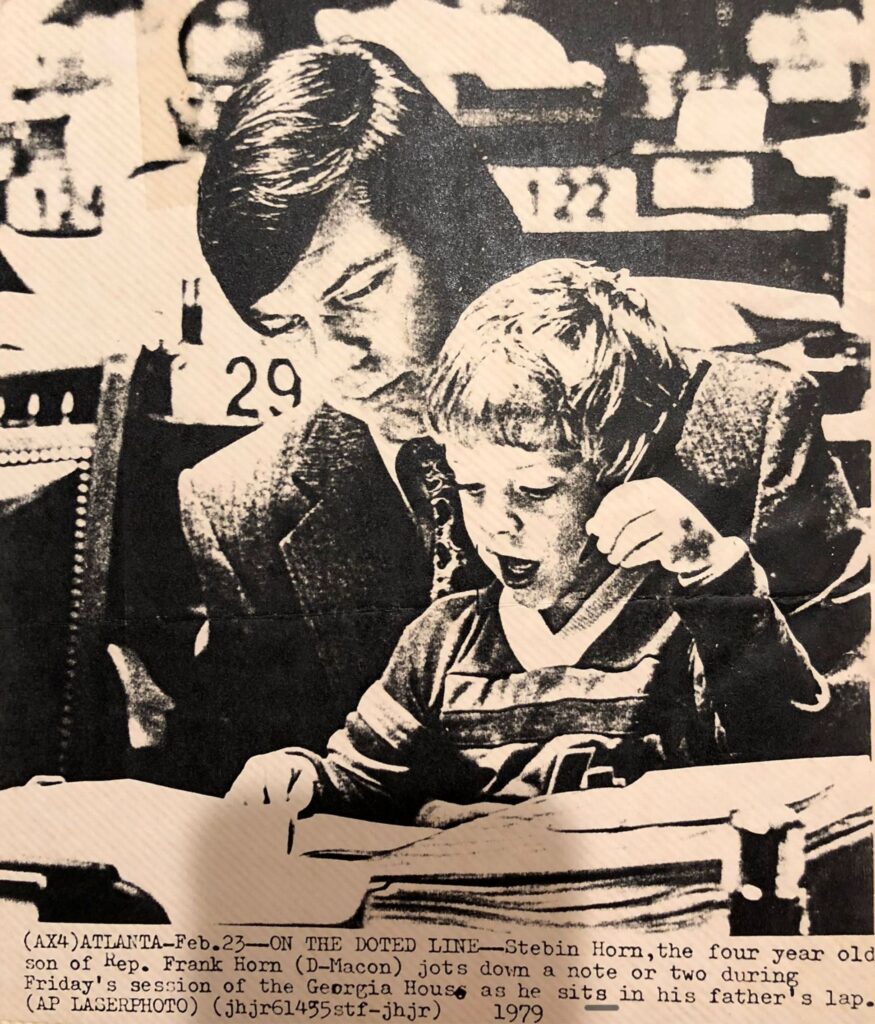
**[INLINE IMAGE: 1979 AP wire photo — Stebin as a four-year-old on his father’s lap during a session of the Georgia House of Representatives. Caption: “Georgia House of Representatives, 1979. Four years old, already on the path.”]**
I grew up in a family of lawyers and judges. Good ones. Well-respected, genuinely successful people who built careers I’m still proud to be related to. The template was drawn before I was old enough to hold a pen: UGA, then Mercer Law, then a real estate practice, then a seat on the Macon City Council — exactly the path my father had walked before me, as a successful attorney and member of the Georgia State Legislature.
It wasn’t a cage. It was a fence, and a handsome one, and for a long time I walked its perimeter because walking it was easier than asking why.
The problem wasn’t the law. The problem was that, for me, it was transactional and boring. Rinse and repeat. Check in, check out. Close the file, open the next one. I was good enough at it to keep going, and that’s the dangerous part — you can spend an entire life being good enough at something that was never really yours.
Honestly? If the 2008 financial crisis hadn’t punched me in the face, I’d probably still be sitting in that office right now, pushing papers and pretending the feeling in my chest was indigestion.
The Bleeding Patient
The crisis took the real estate practice with it, and the family law work wasn’t far behind. So I did what every freshly humbled professional does when the ground gives out — I had a big idea. Healthcare. ObamaCare was reshaping the industry, there was real opportunity, and I jumped in headfirst with a co-founder who happened to be a surgeon.
Here’s a tip, free of charge: don’t try to run a startup with someone whose entire professional training is built on being the most important person in the operating room.
We tried to build a company the way he ran his OR — total control, one voice, no dissent, everything sterilized and perfect before anything was allowed to move. Meanwhile the business was the patient, and the patient was bleeding out on the table, and we were arguing about the lighting.
But that failure did something generous. It cleared the calendar. It pulled the last fence post out of the ground. And for the first time in my adult life, I had a window.
I used it to chase a girl.
The 8,000-Mile Proposal
Her name is Roos-Maryn — Afrikaans for Rosemary. I had met her, fallen hard, and watched her go back to South Africa — because South Africa is where she belonged, even if I didn’t fully understand that yet. So I did the only thing that made sense to a man who had just lost his career, his plan, and his grip on “the sensible option.” I put everything on the line, bought a ticket, and got on a plane with a ring in my pocket and absolutely no guarantee she’d say yes.
Eight thousand miles is a long way to travel with a question in your mouth.
I had told her I was sending Christmas presents from America for her family. She had told me, gently, not to bother — that the postal service in South Africa was unreliable and the package would never arrive. I agreed with her. I agreed with her all the way to the Cape Town airport, where one of her brothers-in-law — a co-conspirator who is still owed a drink for the rest of his life — picked me up in the middle of the night.
**[EMBED VIDEO: “Rose Surprise” (Rose Surprise.mp4) — the box reveal, Dec 27, morning in the Cape Winelands. Thumbnail: mid-scream frame.]**
It was December 27th. Her brother’s vineyard in the Cape Winelands. Her entire family was there for the holiday — her parents, her three sisters, her brother, all the spouses, and eleven nieces and nephews. By seven in the morning it was already 100 degrees. And in the middle of the room, wrapped like a Christmas present that had somehow, miraculously, survived the South African postal service, was me.
She screamed. Then she laughed. Then she pulled me out of the box. Somewhere behind her stood a row of deeply disappointed nieces and nephews who had just realized there were no actual Christmas presents from America.
The ring didn’t come out that morning. I wanted her to have the whole story, not the headline. So I waited. Four days later, on New Year’s Eve, we climbed Paarl Mountain together and I asked her the question I had carried 8,000 miles to ask. She said yes on top of a granite dome older than almost anything I had ever stood on, with the winelands rolling out beneath us and a new year a few hours away.
I’d love to tell you I went for her and happened to notice Africa on the way. That’s not what happened. Africa met me at the airport. The light was different. The air had a weight to it. The horizons were bigger than anything a boy from Georgia had a frame of reference for. And the more time I spent trying to understand Roos-Maryn — her history, her family, her country, her language, the land she came from — the more I realized something I wasn’t prepared for.
She *was* Africa. Beautiful. Strong. Independent. Complicated. Impossible to summarize and impossible to own. The proposal was never going to be about grabbing the girl and dragging her home to America. The proposal was an invitation to unpack who she really was, in the place that made her. And somewhere in that unpacking, my own fences started coming down too.
What Came Back
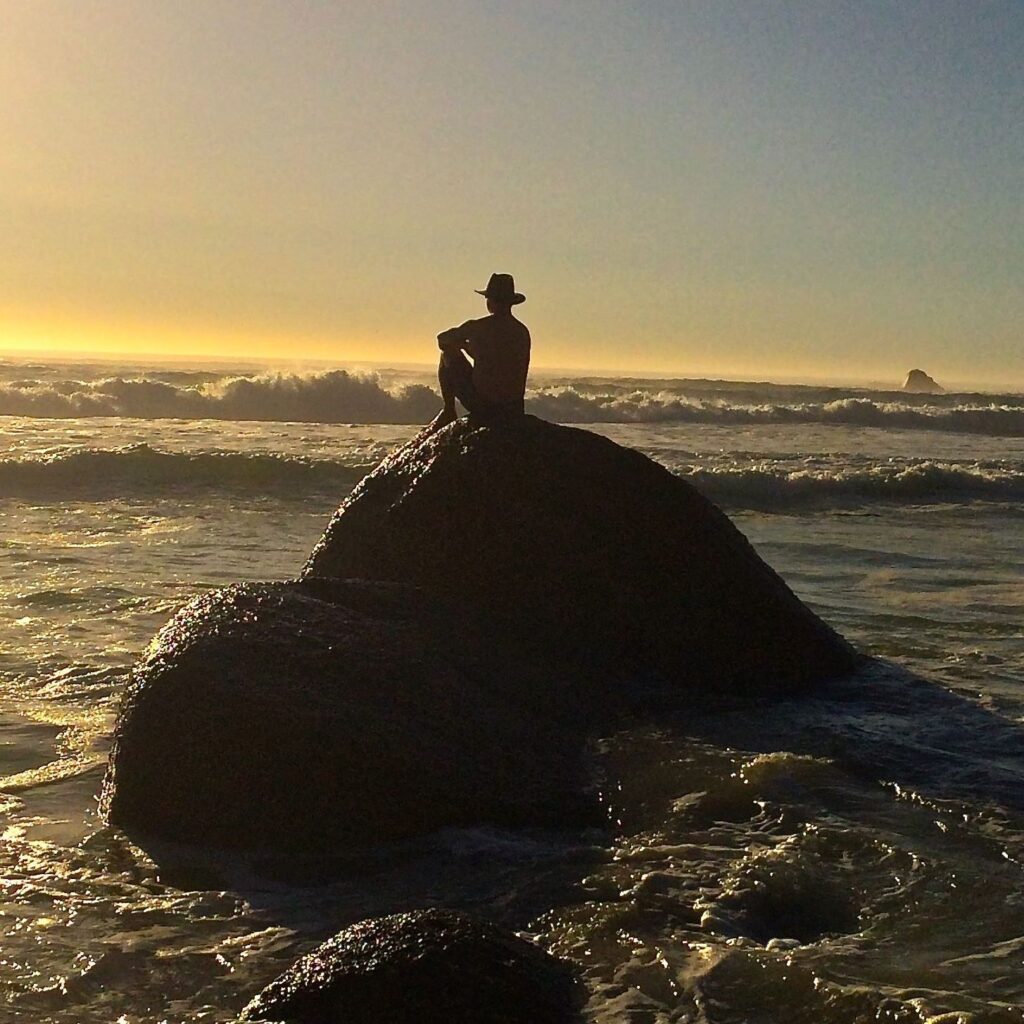
**[INLINE IMAGE: Stebin silhouetted on a rock in the ocean at sunset, hat on, knees pulled up, completely still. Caption: stillness — the other edge of curiosity.]**
People ask me what rewilding actually feels like, and the most honest answer I have is this: curiosity came back. The fences you can’t see are the ones that come down first. A real, genuine, childlike interest in what’s around the next corner. Not the performance of curiosity you put on at a dinner party. The actual thing.
I’ll be straight with you — that’s a double-edged sword. Curiosity untethered will pull you out of the present moment faster than almost anything else. You can spend your whole life chasing the next horizon and miss the one you’re standing in. What I’ve learned, slowly and imperfectly, is that presence is much easier when you’re actually where you want to be. When the life around you is the life you chose, staying in it stops feeling like discipline. It starts feeling like relief.
That’s the part I wish somebody had told me when I was 25 and billing hours I didn’t care about.
The Invitation
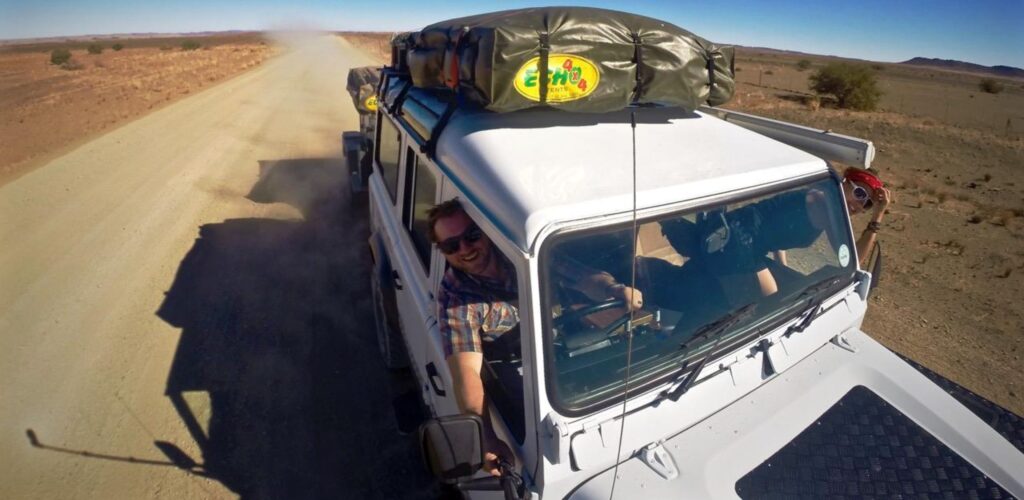
**[INLINE IMAGE: Land Rover drone shot, dust trail on a dirt road, Stebin grinning out the driver’s window, Roos-Maryn in the passenger seat. Caption: around the next corner.]**
Everything I do now — eco-x.travel, our school programs, TILT EcoAfrica, the rewilding work, the business leadership trips — is built around one idea. That the same thing Africa did to me, Africa can do for other people. Students who’ve been handed a template. Executives who’ve been optimized into somebody else’s spreadsheet. Families who want to show their kids a version of the world that isn’t already fenced.
Rewilding isn’t just something you do to a landscape. It’s something you can do to a life. And the wildest part is, once you start, the land helps.
If any of this is speaking to you — if you’re reading this from inside a box somebody else built for you — I’d love to show you what we do. Not a sales pitch. An invitation.
Come see it. Africa has a way of making the introduction itself.